

700,000 hams per year: one of the most highly automated curing facilities in Europe
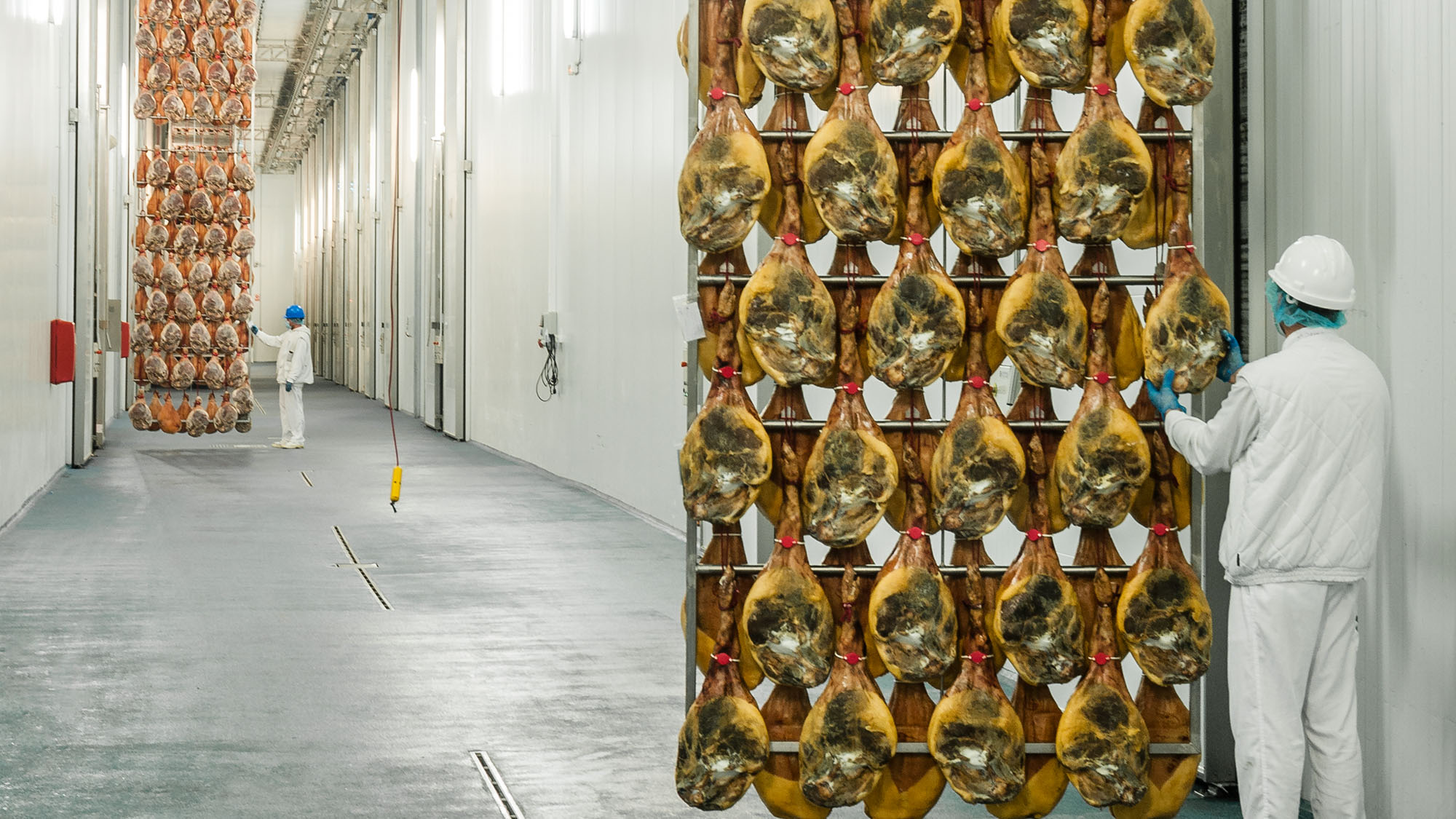
Campodulce’s facility in Zuera combines advanced technology, individual traceability, and traditional curing methods to produce more than 700,000 white-breed pork hams per year.
Spain is home to a vast number of farms dedicated to raising pigs. While we are world-renowned for our Ibérico (Iberian) pork, we are also major exporters of cerdo blanco (white-breed pork). Although the hams produced from these pigs have different characteristics than those from Ibérico pigs, they still offer the same high quality and authentic flavor rooted in our land.
A prime example of how to efficiently organize and operate a production facility for this type of product can be found in Zuera (Zaragoza). This is the site of one of Campodulce’s facilities—specializing in hams from white-breed pigs—which ranks among the most modern in Europe, with an annual output exceeding 700,000 units.
However, reaching such a figure requires more than just large-scale infrastructure or a high-quality raw product. Above all, it demands two key elements: a highly controlled organizational structure across every stage — from the moment the ham arrives at the plant until the final product reaches your table — and the ability to adapt to changing times by modernizing in step with the preferences of new consumers and the demands of today’s market.
An organization designed for excellence
The Zuera plant operates using a unit-based control system: each ham is assigned a unique identifier, allowing it to be tracked individually. This ensures perfect traceability and consistency throughout the entire process.
It is important to note that this is not "mass production" in the generic sense, but rather large-scale production. This approach ensures that control over every single piece is never lost, guaranteeing quality in each and every ham.
Do you know the process involved in making a ham?
Everything begins with salting — a technique that ensures the hams absorb salt uniformly, using the minimum amount necessary to achieve optimal curing. The facility itself considers this an innovative method within the sector, one that is constantly refined through ongoing research and development focused on production and packaging processes.
Following the salting stage comes the curing process in the cellar — a phase where tradition and technology coexist most clearly. The curing chambers are equipped with state-of-the-art technology to ensure maximum product consistency, while still preserving the essence of the traditional curing process: the chambers replicate the natural seasonal cycles (winter, spring, summer, and autumn), just as was done in artisanal curing long before the advent of industrialized control systems.
In addition, a traceability system — using individual chips for each piece — allows for the tracking of every ham from its origin on the farm, through every stage of the production process, until it reaches the final customer.
The final step is the calado (probing), where the master ham-maker has the ultimate say. Before any piece is dispatched to its destination, it undergoes this final quality check to ensure it has reached the perfect level of curing. This involves both feeling the product to verify its degree of maturation and assessing its aroma and flavor to ensure they meet the required standards.
In a sense, this is the only step in the entire process that remains entirely dependent on human judgment, regardless of how much technology is integrated into the rest of the production chain.
A product backed by the most rigorous certifications
This entire process relies on more than just experience and expertise; it is supported by quality departments that work alongside other professionals to ensure the company meets the world’s most demanding quality and food safety standards.
At the end of the day, the figures recorded at a facility like the one in Zuera represent more than just large-scale infrastructure — they reflect an organization that has successfully turned control, traceability, and respect for traditional methods into a genuine competitive advantage.
It serves as proof that large-scale production and meticulous attention to every detail need not be mutually exclusive.